Create a gipsmult object.
This object will contain initial data and all other information
needed to find the most likely invariant permutation.
It will not perform optimization. One must call
the find_MAP() function to do it. See the examples below.
Usage
gipsmult(
  Ss,
  numbers_of_observations,
  delta = 3,
  D_matrices = NULL,
  was_mean_estimated = TRUE,
  perm = ""
)

new_gipsmult(
  list_of_gips_perm,
  Ss,
  numbers_of_observations,
  delta,
  D_matrices,
  was_mean_estimated,
  optimization_info
)
Arguments
- Ss
A list of matrices; empirical covariance matrices. When
Zis the observed data from single class:if one does not know the theoretical mean and has to estimate it with the observed mean, use
S = cov(Z), and leave parameterwas_mean_estimated = TRUEas default;if one know the theoretical mean is 0, use
S = (t(Z) %*% Z) / number_of_observations, and set parameterwas_mean_estimated = FALSE.
- numbers_of_observations
Numbers of data points that
Ssis based on.- delta
A number, hyper-parameter of a Bayesian model. It has to be strictly bigger than 1. See the Hyperparameters section below.
- D_matrices
A list of symmetric, positive-definite matrices of the same size as matrices in
Ss. Hyper-parameter of a Bayesian model. WhenNULL, the (hopefully) reasonable one is derived from the data. For more details, see the Hyperparameters section below.- was_mean_estimated
A boolean.
Set
TRUE(default) when yourSparameter is a result of astats::cov()function.Set FALSE when your
Sparameter is a result of a(t(Z) %*% Z) / number_of_observationscalculation.
- perm
An optional permutation to be the base for the
gipsmultobject. It can be of agips_permor apermutationclass, or anything the functionpermutations::permutation()can handle. It can also be of agipsmultclass, but it will be interpreted as the underlyinggips_perm.- list_of_gips_perm
A list with a single element of a
gips_permclass. The base object for thegipsmultobject.- optimization_info
For internal use only.
NULLor the list with information about the optimization process.
Value
gipsmult() returns an object of
a gipsmult class after the safety checks.
new_gipsmult() returns an object of
a gipsmult class without the safety checks.
Hyperparameters
We encourage the user to try D_matrix = d * I, where I is an identity matrix of a size
p x p and d > 0 for some different d.
When d is small compared to the data (e.g., d = 0.1 * mean(diag(S))),
bigger structures will be found.
When d is big compared to the data (e.g., d = 100 * mean(diag(S))),
the posterior distribution does not depend on the data.
Taking D_matrix = d * I is equivalent to setting S <- S / d.
The default for D_matrix is D_matrix = d * I, where
d = mean(diag(S)), which is equivalent to modifying S
so that the mean value on the diagonal is 1.
In the Bayesian model, the prior distribution for the covariance matrix is a generalized case of Wishart distribution.
See also
stats::cov()– TheSsparameter, as a list of empirical covariance matrices, is most of the time a result of thecov()function. For more information, see Wikipedia - Estimation of covariance matrices.find_MAP()– The function that finds the Maximum A Posteriori (MAP) Estimator for a givengipsmultobject.gips::gips_perm()– The constructor of agips_permclass. Thegips_permobject is used as the base object for thegipsmultobject.
Examples
perm_size <- 5
numbers_of_observations <- c(15, 18, 19)
Sigma <- diag(rep(1, perm_size))
n_matrices <- 3
df <- 20
Ss <- rWishart(n = n_matrices, df = df, Sigma = Sigma)
Ss <- lapply(1:n_matrices, function(x) Ss[, , x])
g <- gipsmult(Ss, numbers_of_observations)

g_map <- find_MAP(g, show_progress_bar = FALSE, optimizer = "brute_force")
g_map
#> The permutation (1,2,5,3,4):
#>  - was found after 67 posteriori calculations;
#>  - is 8.528e+22 times more likely than the () permutation.

print(g_map)
#> The permutation (1,2,5,3,4):
#>  - was found after 67 posteriori calculations;
#>  - is 8.528e+22 times more likely than the () permutation.

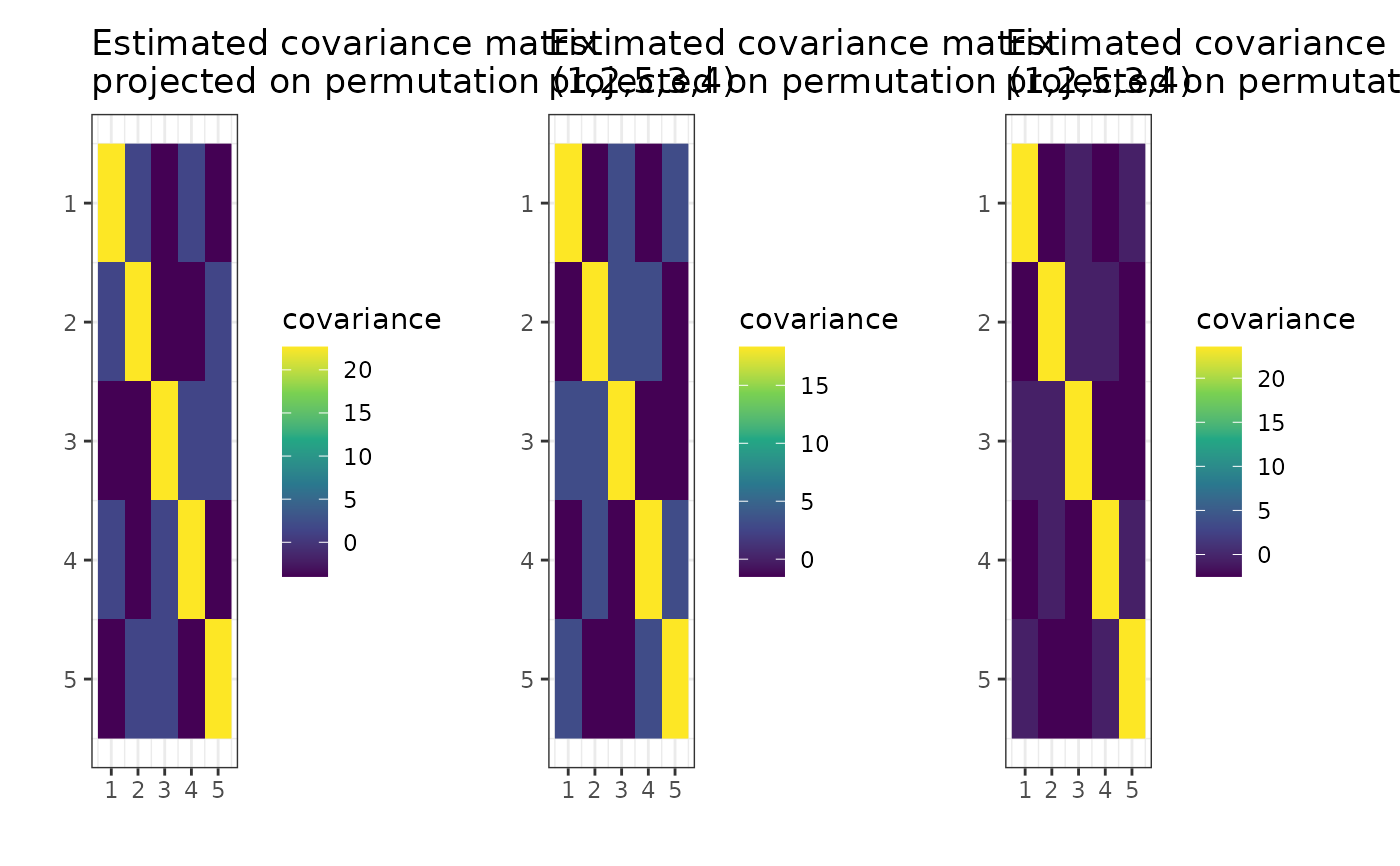
if (require("graphics")) {
  plot(g_map, type = "MLE", logarithmic_x = TRUE)
}