Use one of the optimization algorithms to find the permutation that maximizes a posteriori probability based on observed data. Not all optimization algorithms will always find the MAP, but they try to find a significant value.
Usage
find_MAP(
  g,
  max_iter = NA,
  optimizer = NA,
  show_progress_bar = TRUE,
  save_all_perms = FALSE,
  return_probabilities = FALSE
)
Arguments
- g
Object of a
gipsmultclass.- max_iter
The number of iterations for an algorithm to perform. At least 2. For
optimizer = "BF", it is not used; foroptimizer = "MH", it has to be finite; foroptimizer = "HC", it can be infinite.- optimizer
The optimizer for the search of the maximum posteriori:
"BF"(the default for unoptimizedgwithperm size <= 9) - Brute Force;"MH"(the default for unoptimizedgwithperm size > 10) - Metropolis-Hastings;"HC"- Hill Climbing;"continue"(the default for optimizedg) - The same as thegwas optimized by (see Examples).
See the Possible algorithms to use as optimizers section below for more details.
- show_progress_bar
A boolean. Indicate whether or not to show the progress bar:
When
max_iteris infinite,show_progress_barhas to beFALSE;When
return_probabilities = TRUE, then shows an additional progress bar for the time when the probabilities are calculated.
- save_all_perms
A boolean.
TRUEindicates saving a list of all permutations visited during optimization. This can be useful sometimes but needs a lot more RAM.- return_probabilities
A boolean.
TRUEcan only be provided only whensave_all_perms = TRUE. For:optimizer = "MH"- use Metropolis-Hastings results to estimate posterior probabilities;optimizer = "BF"- use brute force results to calculate exact posterior probabilities.
These additional calculations are costly, so a second and third progress bar is shown (when
show_progress_bar = TRUE).To examine probabilities after optimization, call
get_probabilities_from_gipsmult().
Details
find_MAP() can produce a warning when:
the optimizer "hill_climbing" gets to the end of its
max_iterwithout converging.the optimizer will find the permutation with smaller
n0thannumber_of_observations
Possible algorithms to use as optimizers
For every algorithm, there are some aliases available.
"brute_force","BF","full"- use the Brute Force algorithm that checks the whole permutation space of a given size. This algorithm will find the actual Maximum A Posteriori Estimation, but it is very computationally expensive for bigger spaces. We recommend Brute Force only forp <= 9."Metropolis_Hastings","MH"- use the Metropolis-Hastings algorithm; see Wikipedia. The algorithm will draw a random transposition in every iteration and consider changing the current state (permutation). When themax_iteris reached, the algorithm will return the best permutation calculated as the MAP Estimator. This algorithm used in this context is a special case of the Simulated Annealing the user may be more familiar with; see Wikipedia."hill_climbing","HC"- use the hill climbing algorithm; see Wikipedia. The algorithm will check all transpositions in every iteration and go to the one with the biggest a posteriori value. The optimization ends when all neighbors will have a smaller a posteriori value. If themax_iteris reached before the end, then the warning is shown, and it is recommended to continue the optimization on the output of thefind_MAP()withoptimizer = "continue"; see examples. Remember thatp*(p-1)/2transpositions will be checked in every iteration. For biggerp, this may be costly.
See also
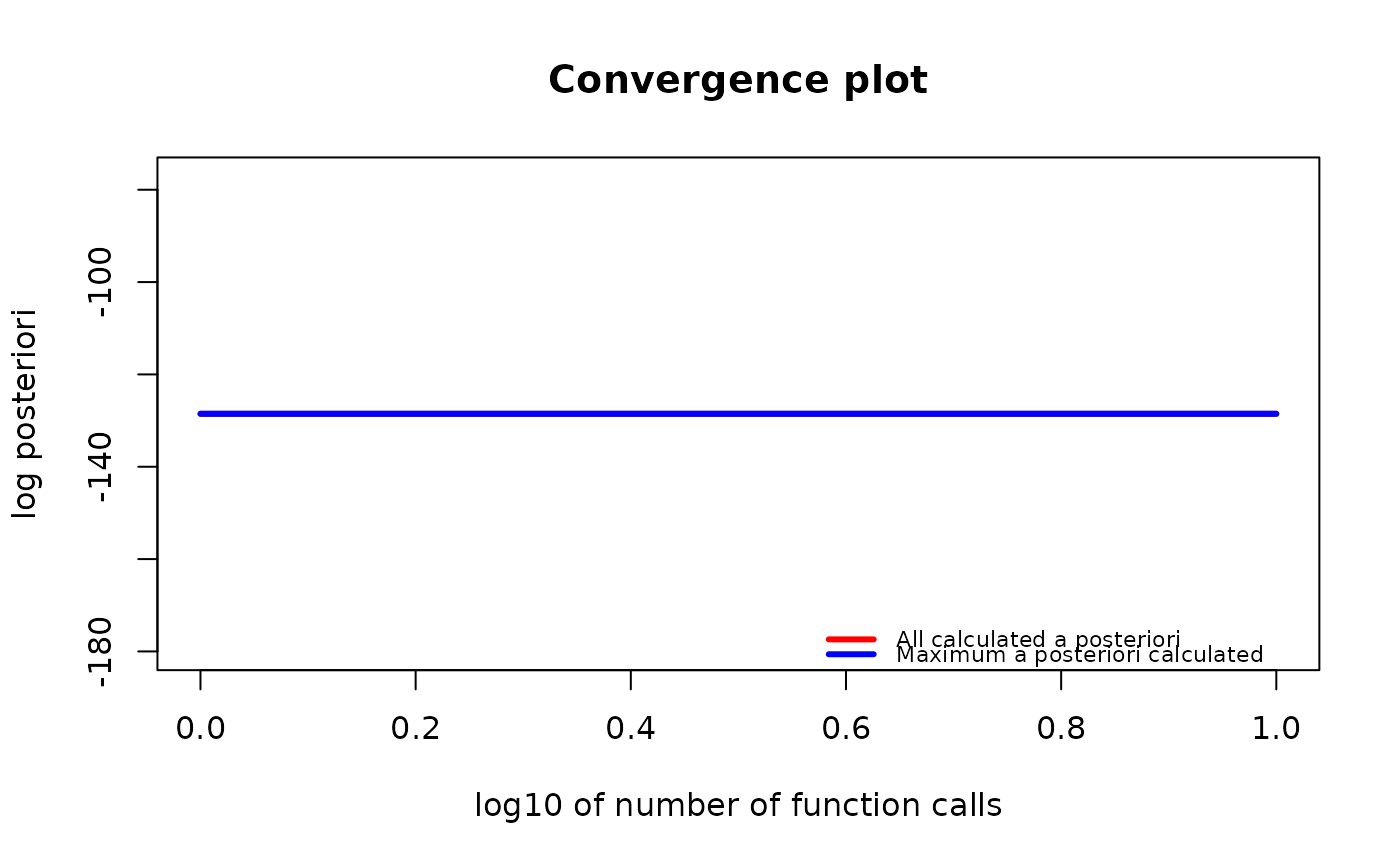
gipsmult()- The constructor of agipsmultclass. Thegipsmultobject is used as thegparameter offind_MAP().plot.gipsmult()- Practical plotting function for visualizing the optimization process.get_probabilities_from_gipsmult()- Whenfind_MAP(return_probabilities = TRUE)was called, probabilities can be extracted with this function.log_posteriori_of_gipsmult()- The function that the optimizers offind_MAP()tries to find the argmax of.
Examples
require("MASS") # for mvrnorm()
#> Loading required package: MASS
perm_size <- 6
mu1 <- runif(6, -10, 10)
mu2 <- runif(6, -10, 10) # Assume we don't know the means
sigma1 <- matrix(
data = c(
1.0, 0.8, 0.6, 0.4, 0.6, 0.8,
0.8, 1.0, 0.8, 0.6, 0.4, 0.6,
0.6, 0.8, 1.0, 0.8, 0.6, 0.4,
0.4, 0.6, 0.8, 1.0, 0.8, 0.6,
0.6, 0.4, 0.6, 0.8, 1.0, 0.8,
0.8, 0.6, 0.4, 0.6, 0.8, 1.0
),
nrow = perm_size, byrow = TRUE
)
sigma2 <- matrix(
data = c(
1.0, 0.5, 0.2, 0.0, 0.2, 0.5,
0.5, 1.0, 0.5, 0.2, 0.0, 0.2,
0.2, 0.5, 1.0, 0.5, 0.2, 0.0,
0.0, 0.2, 0.5, 1.0, 0.5, 0.2,
0.2, 0.0, 0.2, 0.5, 1.0, 0.5,
0.5, 0.2, 0.0, 0.2, 0.5, 1.0
),
nrow = perm_size, byrow = TRUE
)
# sigma1 and sigma2 are matrices invariant under permutation (1,2,3,4,5,6)
numbers_of_observations <- c(21, 37)
Z1 <- MASS::mvrnorm(numbers_of_observations[1], mu = mu1, Sigma = sigma1)
Z2 <- MASS::mvrnorm(numbers_of_observations[2], mu = mu2, Sigma = sigma2)
S1 <- cov(Z1)
S2 <- cov(Z2) # Assume we have to estimate the mean
g <- gipsmult(list(S1, S2), numbers_of_observations)
g_map <- find_MAP(g, max_iter = 5, show_progress_bar = FALSE, optimizer = "Metropolis_Hastings")
g_map
#> The permutation (2,5):
#> - was found after 5 posteriori calculations;
#> - is 183.596 times more likely than the () permutation.
g_map2 <- find_MAP(g_map, max_iter = 5, show_progress_bar = FALSE, optimizer = "continue")
if (require("graphics")) {
plot(g_map2, type = "both", logarithmic_x = TRUE)
}
 g_map_BF <- find_MAP(g, show_progress_bar = FALSE, optimizer = "brute_force")